
Philip Arnold
The Road AS Photographic Object
Between departure and a destination there is a road. Both under the wheel and also the beyond to a chosen place, the road is an elaboration of the distance between. It is the lineation of a journey’s narrative. The exile, pilgrim, and wayfarer have run its archetypal course, and upon it summoned allegorical depths that render transit into transformation. The residential route and backcountry shortcut are its progressions in the vernacular. Although more traveled as a means to an end, the road is also its collective measure of the thousands upon thousands of miles it is traveled upon. In all and by degree, its momentum is of longing.
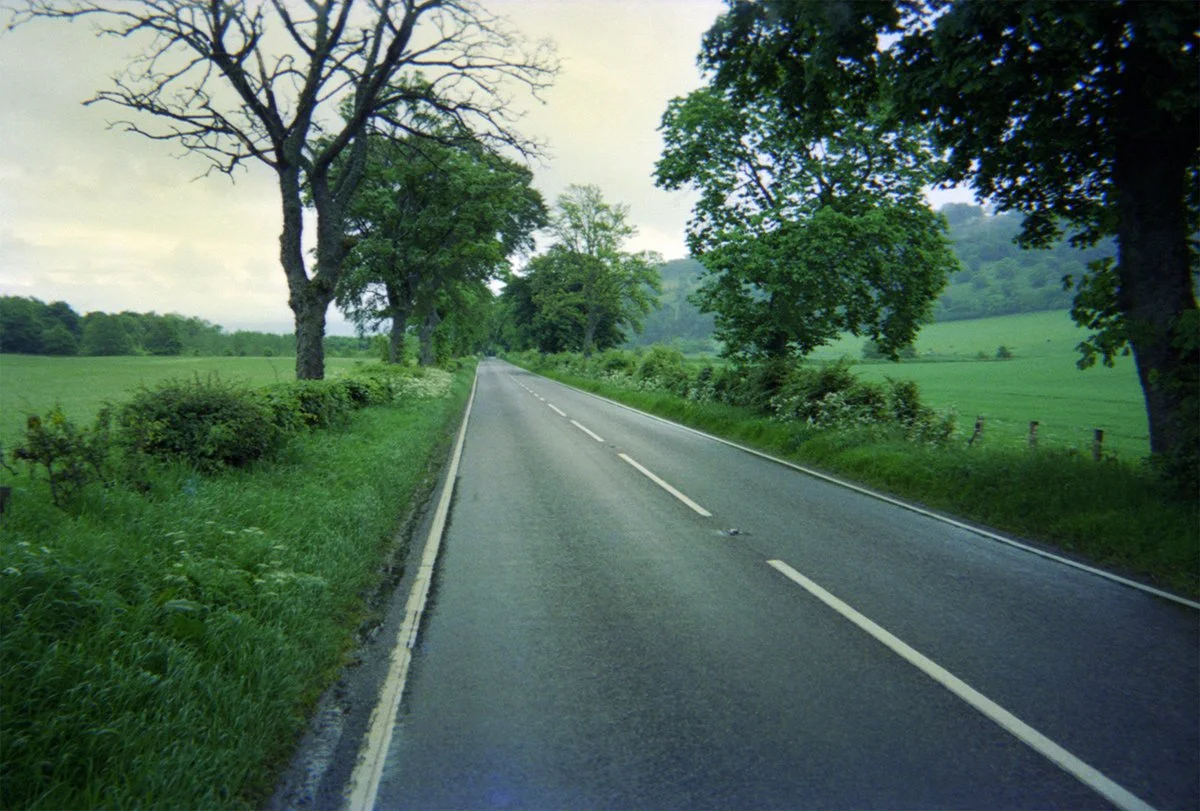
Geometry advises us the line is infinite. The roads I follow from Glasgow on the Scottish mainland and north to the Orkney and Shetland Islands are both boundless in the moment and terminal. Where a road ends at the edge of an island, a ferry delivers me to the next one. As my travel advances according to a specific destination—to arrive at the cliffs of Hermanness on the Isle of Unst—my methodology matters: the ardor-under-strain necessary to bike the wind-blunting miles of my journey will clarify the value of arriving at its end.
Negatives from a disposable 35mm film camera, digitally rescanned to replace long lost photographs, are artifacts of the original experience from twenty-seven years ago. These photographs are one version of the journey, each one fragmentary and sequential. Countryside peripheries were narrowed within the frame in order to center an object—the road. The significance of the road evolved from the relationship I entered into with it—it would carry me onward, it would reference my northern intentions, it would remain with me when all else around me shifted and changed. The road would be my home, every mile a new room.
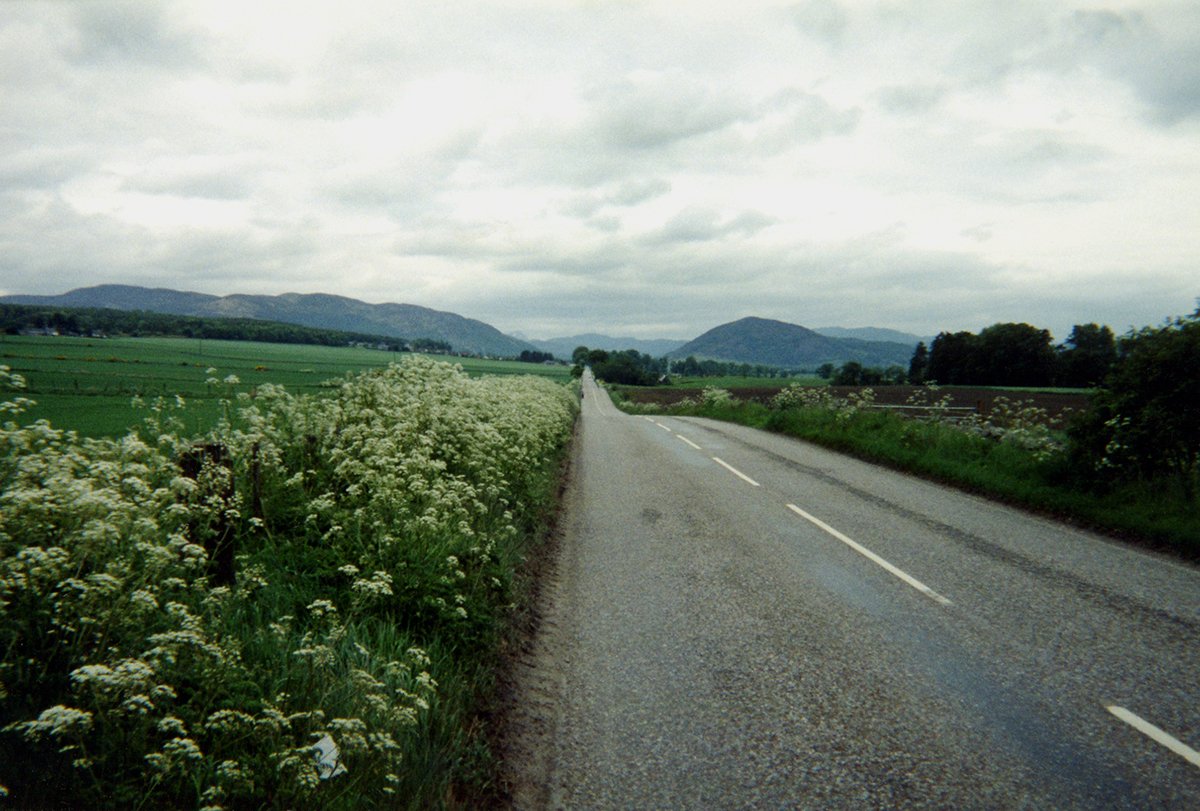
A photograph can give shape to and order the past. It offers a visual representation of a former experience, akin to a memory. There are equivalences, but a photograph or a memory of this ride is not the ride. At least they are of the present moment. To the degrees they are, they may unsettle the other. How might recovered photographs vitalize or resolve my memory of gliding over roads to Scotland’s far north?
All horizons from the road engender a sense of incompleteness, and its reflex, curiosity. Though they are a figment of perspective, always receding and realigning, horizons may be experienced in the absolute. At the end of my road, its proverbial end, was a dragon. Its sinuous tail trailed North to a sea-surrounding glimmer of sun pulse and whirling winds. On long rides, metaphors are as essential as carbohydrates. The road was my questing path, every mile on my bike a preparation for the journey’s physical and psychic outcome.
Existing within the space of a photograph, the road belongs to an aesthetic form that allows an interpretation according to the techniques and aesthetic conventions of the genre. In consideration are the photographs’ tone and texture and structure. The road functions as a leading line in my images—a photographic technique that uses a line or lines within a composition to guide the viewer’s eye to the subject of the photograph. But not always. In these photographs, the road, as an object, points to the composition’s subject, itself. The road is both referrer and visual referent.
Green space is the dividend of the roads’ divide. The road may appear as a seam in the fabric of the landscape; however, in its compositional centering, the road’s presence is rhetorical and underwrites its imperative over its surroundings. Each road becomes its own landscape, its own micro-ecology of wayfinding and wayfaring, scalable according to the depth of distance it reveals.
It goes without saying that a photograph in its taking isn’t a photograph: it is an intention. As a series, the photographs bring into order my trip’s logistical timeline, as I remember it. Teeming in the actual, they provide clarity to the journey’s sequence of days and the absence of trees the further north I rode, until there were none. They remind me of the long hours when the road felt serialized and conjunctive, and even telepathic. They recall the slow landscapes of epically barren detail and scenes of boundaried seawaters and omened clouds.
As each photograph is a fragment of the whole journey, its symbolic summoning and logistical revising works best in the collective. The photographs assemble a visual narrative when viewed as a perspectival series: the eye aligns road to road as a continuous line, pointing compass arm-like to the North of my destination. The photographs as a collective, though, also offer each road as iterative. They do not suggest an intensity of context or moment. If taken a bit further down the road, the roads and their narrow peripheries of sky and greenscape would appear essentially the same.
This absence of singularity elevates each road to an abstraction. While documenting the moment in time over which it was ridden, the road animates an onwardsness—an interval of latitudinal progression wherein the road, as an object, signifies a beyondness that the photograph does not contain. Representing an insistence of direction, a forbearance of duration, and a summoning depth, the road points to a yearning for a distance still beyond arrival.
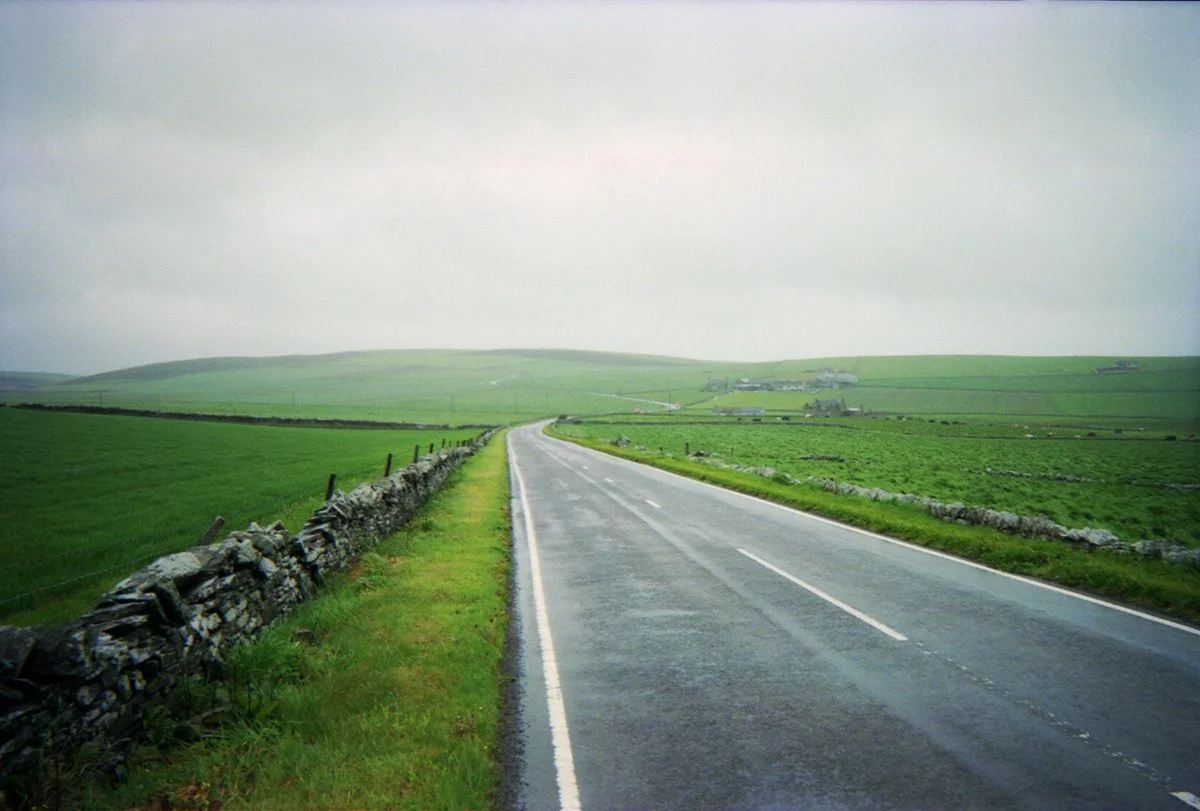
There are more memories of my bike trip than photographs of it. The power of memory is that it can flex: it is always in draft form. A photograph can destabilize or regroup memories. It can counter the contours of embellishment and omission, as well as it can conclude a memory—fixing prior recollections of a landscape to their fixed image.
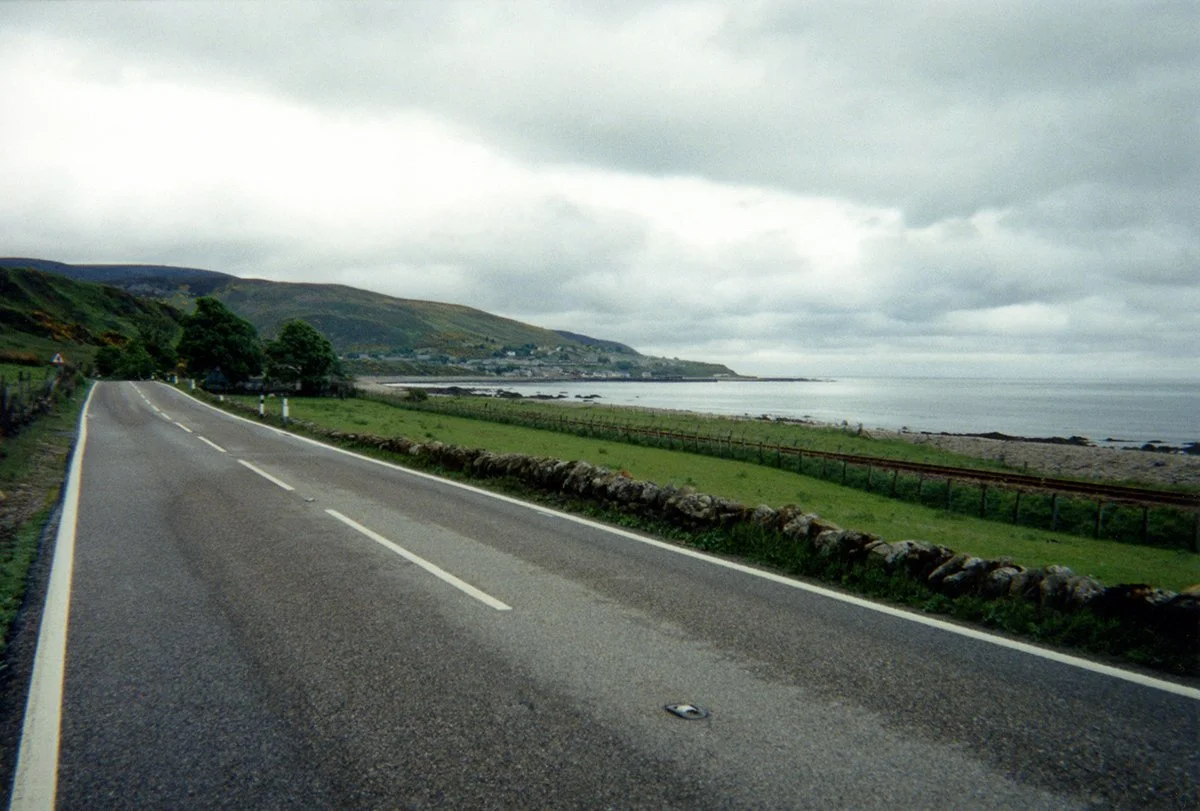
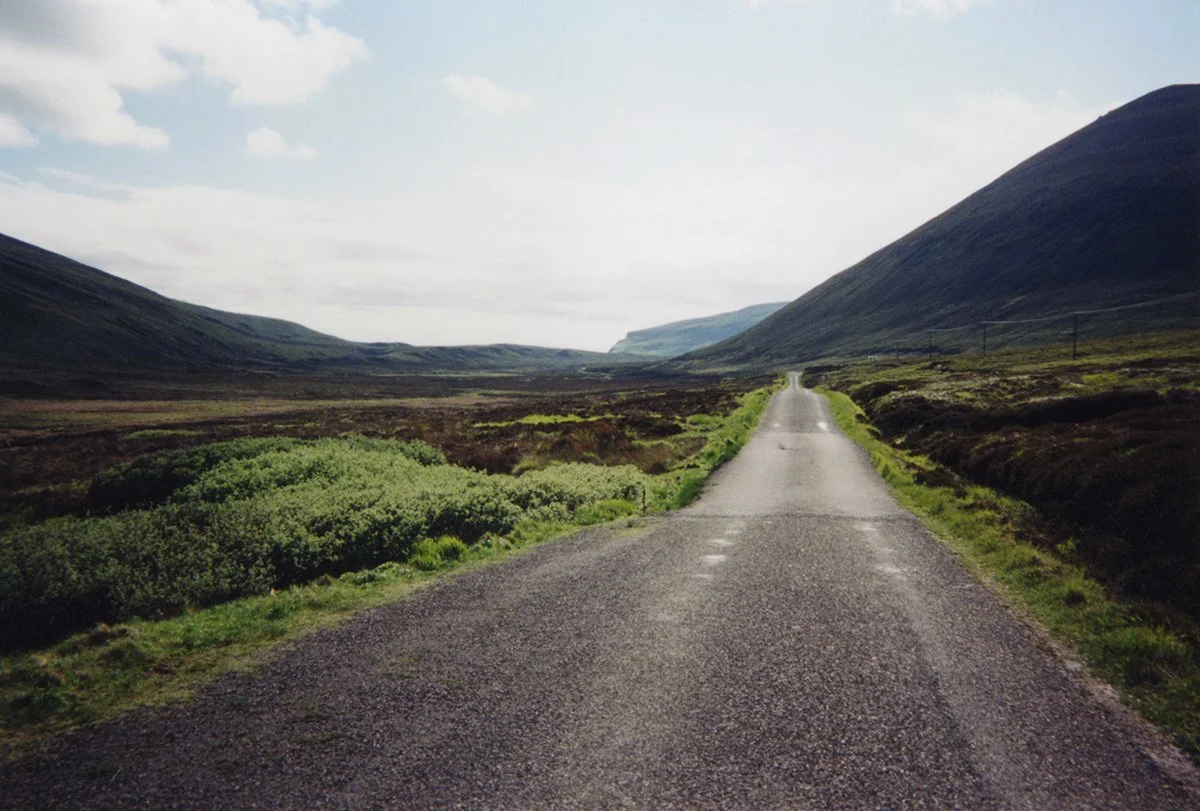
My recollection of biking through a sheltering solitude to Rackwick on the Isle of Hoy I now enter through my photograph of the single-track road that enters the wild moorlands of this Orcadian island. This photograph more than rekindles a place, it prefigures my memories of Hoy en masse. It offers a scene that book covers other recollections of the island’s hilly intersections of blue skies and expansive glens that open to the sea. The photograph of the road that skirts the North Atlantic on the island of Yell now preambles my otherwise fuzzy details and sensations of riding north through the Shetland Islands. These two photographs are gateway images that not only re-open the latent and forgotten, restoring clarities to the original experiences, but they more broadly contextualize my imagined encounters from further down the road.
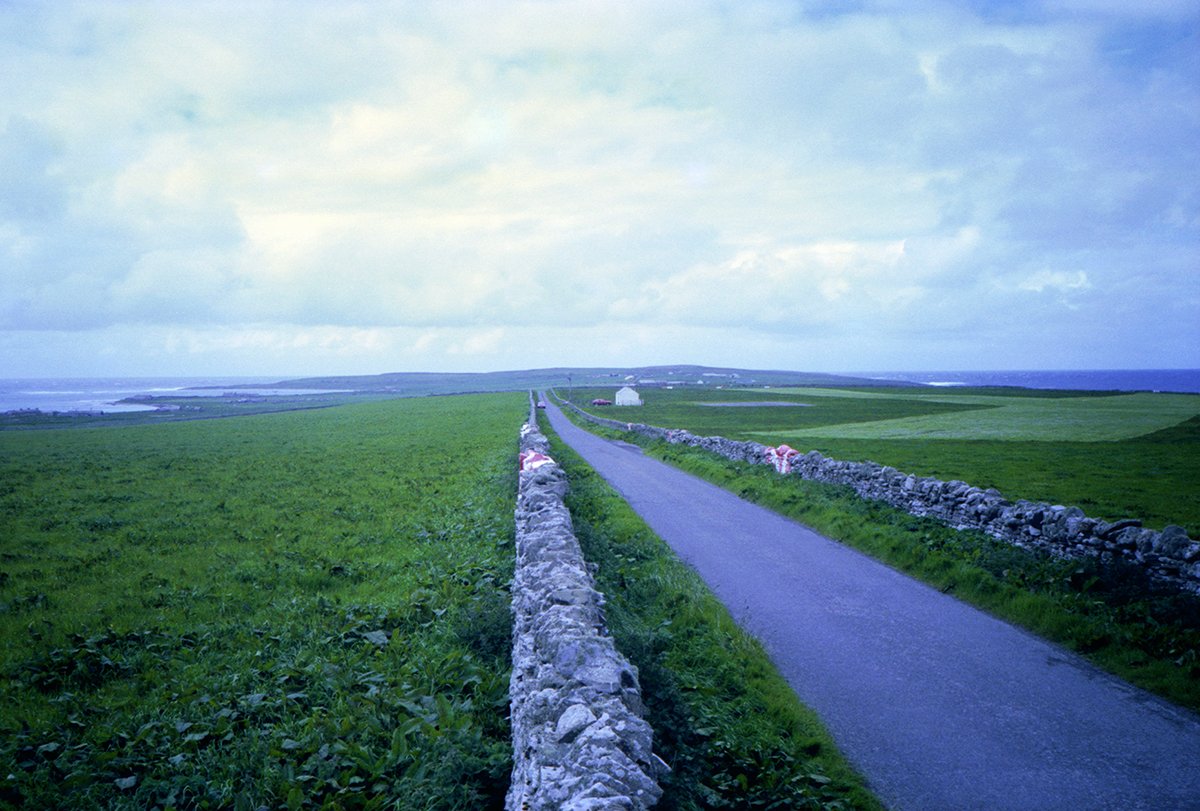
While my road photographs recalibrate the granularity of past moments, there is still a limit to the environments they can reveal beyond their fixed frames. They also, in my experience, lack memory’s metabolizing energy to conjure a visceral presence of the past. I say this within the context of the subject at hand—a biking journey whose modus was an embodied momentum churning onward to a foreordained end. In this spirit, a memory is not unlike a bike gliding through a remote land: both are fluid and responsive to imagined depths, as are their environments associative, uncertain, and easily destabilized.
While I can view the open road in a photograph, it is difficult to key the rhythm of my cycling to the miles’ murmurations from it. Memory, though, revives the intimate enclosure of the terrain’s contours and gradients and the velocities through which I navigated them. Straight-away distances are pulled back beneath the wheels as though the roads usher forth from my bike as much as they lay ahead. As their compositional structure is the resonance of accrued miles, these memories narrate a restored motion toward a summoning horizon.
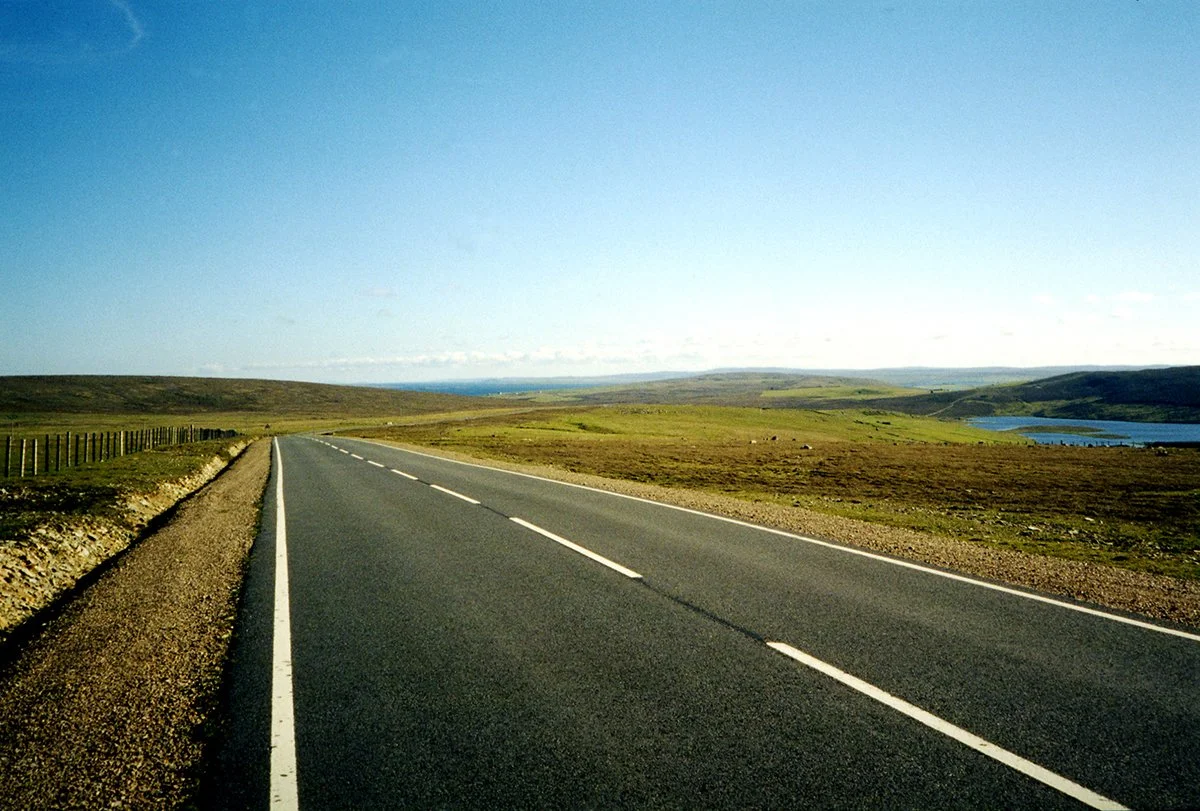
Perhaps the point I am moving toward is that in its stasis a still photograph cannot suggest the winds—or at least not the winds through a treeless countryside. Over every road of my trip the wind never resolved: it swirled and hurled and crowded in to pick my bones. Every one of my memories over mainland and island edge is accompanied by a headwind. To come to terms with its relentless force I gave it an origin and purpose: its orientation Hyperborean, and my own—straight into the heart of the dragon’s breath.
The strange contradiction and potential of the road is that while on it, it remains hypothetical—both a real and speculative opportunity. Any given moment on it is provisional. Those moments selected or embedded to last were of a present overextended into borrowed time. If the road as a photographic object provides an anchoring presence to the original experience, the road of memory can go off-road, and engage in fictions. Both modes of representation, captured either on film or imagined, are ultimately routes to the same thing—a narrative that tethers a loose hold of a horizon. How we access the road is one thing: where it takes us is another.
* * *
Philip Arnold is a writer located in New Albany, Ohio. A grateful recipient of an Excellence Award from the Ohio Arts Council, his writing has appeared in Southern Humanities Review, Iowa Review, Arts & Letters, Blackbird, Sonora Review, Tahoma Literary Review, and Soundings East. He is the author of the poetry collection The Natural History of a Blade (Dos Madres Press, 2019). His nonfiction has been selected as notable in the Best American Essays series.